Tuesday, 25 June 2019
Live peeks part 1: LP
I saw LP live at the 02 Ritz in Manchester back in late May and was struck by her charisma and the operatic scale of her performance.
My place in the crowd wasn't great, and I had my face groped by a drunk woman (I will be returning to this story at some point I think...) but I had a great time nonetheless.
The video to 'Shaken' has just come out, and while it's not a live video, it is worth a watch.

Sunday, 23 June 2019
Better Buses for Greater Manchester: FourGoods and forays into 'proper' journalism
 |
| There's definitely a story in this... |
To explain, there is a certain snobbery within the world of journalism vis a vis music journalists; a sense that we aren't 'proper' writers and we aren't deploying journalistic skills and training. Which, given the high standards of research and quality of writing that you see in a lot of long form music and cultural commentary, feels very unfair.
It goes without saying that there's an equal amount of snobbery and scorn directed at bloggers by journalists in general (including music journalists): We write for free! Without editors! We have no training or discipline! Which, admittedly, is hard to argue with at times. That said, just because you write for free, without an editor, with no training doesn't mean you can't write. Sometimes it does, but not always. I'd also say, on the financial renumeration point, that platforms like Medium as well as crowdfunding platforms like KoFi and Patreon are muddying the waters so far as the 'unpaid' aspect of it goes.
Personally, I'd say that I occupy a weird hinterland that I'd like to call 'Semi professional journalist/blogger', meaning that I do write for free, but I also get paid for my work sometimes. I've also written for free in an academic context, but because it's in an academic context it's fine and not shameful. Which is a bit of a headfuck it has to be said. Ultimately, I would like to be a fully professional writer, but (for various reasons) it just isn't happening at the moment.
I started writing pieces for the website FourGoods earlier this year. They commissioned me to write about veg box schemes and Brexit (this was before the deadline for Brexit was extended to the 31st October) and, more recently, the campaign to re-regulate the buses in Greater Manchester.
There was no byzantine recruitment process, no weird unwritten rules to somehow know by osmosis and comply with... I simply pitched the veg boxes and Brexit idea to them, they liked my pitch, read my stuff on Medium and concluded that I had the right tone of voice for their publication, and that was it: I was commissioned, I was in. I'd like to say that this happens a lot, but it doesn't: My pitches have a success rate only marginally above the proverbial snowball in hell.
Anyway, back to those buses...
As with most of the UK (London is the exception) the buses in Greater Manchester were de-regulated in 1986 and it's been chaos ever since. It's long been a source of disappointment to me that there seem to be so few people in the UK who care about bus travel, who want to change it for the better, who are willing to stand up and make a fuss about it and agitate for a better deal. After all, commuter groups have been doing just that with trains pretty much ever since the trains were privatised in 1994.
Then, I heard about Better Buses For Greater Manchester. I met Pascale Robinson, saw the campaigners in action, and the rest they say is history.
I have learnt a lot about journalism while writing for FourGoods, and it's also taught me a lot about pitching I think as well. Particularly about not pitching too soon, before you've worked the idea out properly, which I know I've done in the past.
I am looking forward to writing for them again at some point.
Photo by Andraz Lazic on Unsplash
Friday, 21 June 2019
Beats: The rave film you didn't know you needed

I wasn't sure at first. Mainly because it's a rave film and, in the 1990s, I was a riot grrrl. That said, I do remember feeling a frisson of excitement when Castlemorton happened. If you weren't alive at the time, it's hard to overestimate the shock waves this one illegal rave caused back in 1992. Some people still think it was singlehandedly responsible for the introduction of the Criminal Justice and Public Order Act 1994. Four days of hedonism, trespass, drugs and rave music in Wiltshire over the May bank holiday weekend certainly caused as much of a political stir as the Poll Tax Riots had two years previously, and those four days so shook the constabulary and society that it caused questions to be asked in Parliament. I'm not exaggerating here: It is a matter of public record, distilled beautifully into digestible and highly evocative text by Matthew Collin in his book Altered States.
I watched the trailer for Beats. It looked good, I said yes.
Unfortunately, I forgot to put the date for the press night in my planner and, consequently, forgot to attend the Printworks on that particular evening.
I only realised what I'd done a day or two afterwards when I was listening to Lauren Laverne on 6music one morning and she was interviewing the director, Brian Welsh, about the film. "I wonder when that screening is" I mused, searching through my emails. Then "Oh...bugger..."
I watched the trailer again. The film still looked good.
I paid to go and see it at HOME that week instead.
Because I watched it at about three o'clock in the afternoon with about three other people, I wouldn't say it was quite the right dynamic, audience wise, but the film was still brilliant.
I'd seen Human Traffic back in the early 2000's, and while bits of it are funny, it's not what you'd call realistic. Beats, on the other hand, is the natural heir to the kitchen sink drama and, as such, it is very realistic, very compelling, and very, very good.
You can read my review here.
Wednesday, 19 June 2019
Punk: Two different generations, two different projects

She's A Punk launched in February 2019 and making it is a real labour of love for Siobhan: Despite working all day with audio in her day job, she spends her evenings and weekends recording interviews with inspirational punk women and editing those interviews into podcast episodes. She's doing the project entirely independently, DIY punk style.
In a related note, a couple of weeks ago I finally had the pleasure of seeing the finished version of Gina Birch and Helen McCookerybook's documentary film Stories from the She-Punks: Music with a different agenda.
I interviewed Gina and Helen about the project for The F-Word back in October last year, and I wrote about the work in progress version of the film back in 2016, so it was brilliant to see the final version.
Because I really, really love this film and I wanted to write about it for a new audience, I pitched the idea of a preview or review of the She-Punks to Louder Than War, who were very happy to commission me to write it.
Thinking about these two projects, I'm struck by how inspirational they both are. Both were borne of a combination of love and frustration: Frustration that their voices were not being heard. Women have been written out of punk histories for a long time, and it was a need to redress this imbalance that led Gina and Helen to make their film. Similarly, Siobhan began making She's A Punk because she couldn't find a podcast for women like her: Independent, awkward, resourceful women. Punk women.
While Siobhan's podcast could be seen as covering a different generation of punk women to the She-Punks, she has a very wide ranging definition of punk which should see her range of interviewees head off in all sorts of directions in the future. The She-Punks project, on the other hand, is part of a different but related narrative: A patchwork of punk women accounts now being written, published, shared, filmed... Most recently there has been Celeste Bell and Zoe Howe's Poly Styrene book, and Jordan Mooney has also recently published her memoirs. Serendipitously (well, for me anyway...) Between Two Books have just announced that their next book, which will be discussed at British Summer Time fest on July 13th, will be Lavinia Greenlaw's 2007 classic The Importance of Music To Girls. This memoir, while not exclusively about punk by any means, does touch on it. It was published in the same year as Helen Reddington's book The Lost Women of Rock Music, an academic account of punk's lost women musicians. Zillah Minx's She's A Punk Rocker, another DIY punk documentary, was released that year too.
Sometimes I think 'Surely there is enough evidence now? Enough accounts to re-dress this collective amnesia as regards women's creative and cultural input into punk?'. Then I'll read something, or I'll hear something, and I'll know that while we may have won a few battles, we are a long, long way away from winning the war.
Wednesday, 8 May 2019
Sticks ’N’ Strings: A manifesto
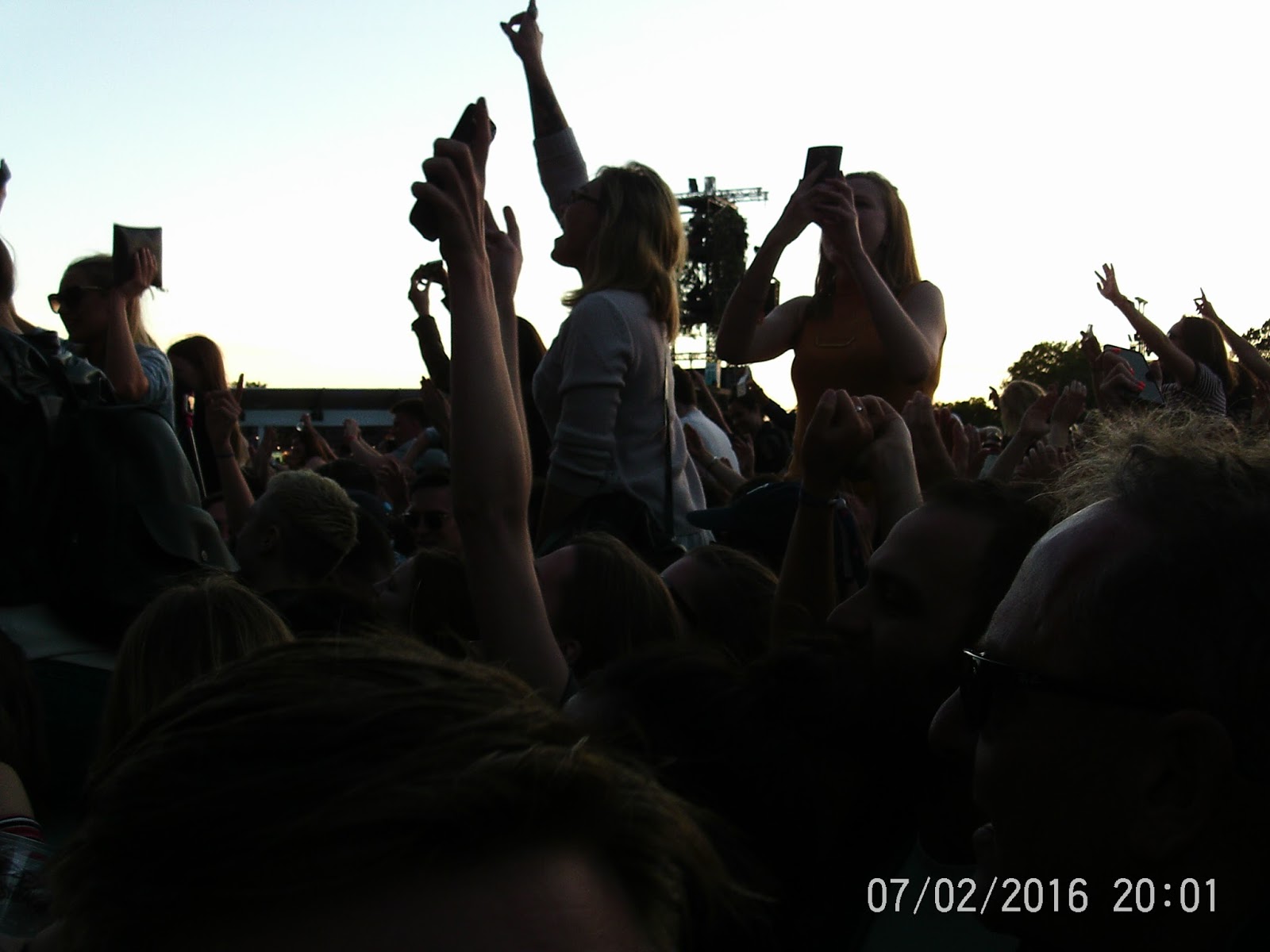 |
| The image of Florence + The Machine fans at British Summer Time Fest never gets old... |
Why Sticks ’N’ Strings?
Over the past ten - fifteen years digital disruption has shifted the economic focus of the music business away from record sales towards live music. It is no longer enough for bands to have a platinum selling album: Not when you need 100 streams of a song to count as one sale and payment per stream is so low. If you want to have a successful career you must sell a lot of t-shirts and tour. A Lot. For years at a time, on as many continents as possible.
From a fan point of view, bands and artists who might previously have been less available to you are now much more accessible to fans thanks to social media. Also, whereas once you might have seen your favourite band live about once every five years or so, now you’re seeing them at least once every couple of years, often more than that. In an experience economy led age, more and more people are going to gigs, and to festivals. Sadly, where you get increasingly large groups of people, you also get an increased statistical likelihood that bad stuff will happen.
Women being groped at gigs. Women being sexually assaulted at music festivals. Women being upskirted at music festivals. And the more subtle behaviours that can also ruin a woman’s night out.
It doesn’t happen to everyone, but it happens often enough to send a specific message.
That perhaps our concert halls, clubs, pubs, arenas and festival sites are places where women and girls are not welcome on our own terms. That our attendance and enjoyment is contingent on the whims and behaviours of the men in the crowd, and the unspoken assumption that women’s bodies are always up for grabs, whether on a crowded train or up against a barrier at a concert.
The UK Live Music Census 2017 highlighted that 66% of music venues surveyed “do not have a sexual harassment policy” and that, similarly, 87% of promoters surveyed “do not have a sexual harassment policy”. The survey raises similar concerns about child protection and terrorism and page 71 of the census report covers specific recommendations to address these issues.
If we move from the moshpit to the stage, things aren’t necessarily any better. The ratio of women headlining music festivals in the UK in comparison to the talent pool available to organisers, is woeful. Having reported on the issue in 2017, the BBC returned to the issue in 2018 to see if things had improved: They hadn’t.
In a related note, there’s no guarantee that even if you score a headline slot on a tour or at a festival that you’ll be paid as much as your male contemporaries: HAIM famously sacked their booking agent last year after being paid a tenth of the fee of a male performer they shared a festival bill with. They have since hired Florence + The Machine’s booking agent, Emma Banks. On the subject of Ms Welch, while Florence headlined Glastonbury in 2015, making her the first British woman this century to do so, and the youngest person in a long time to do so, she hasn’t headlined Glastonbury since and, British Summer Time aside, the festivals she does headline are the smaller ones. That she sells out both her arena tours and these smaller festivals would suggest, once again, that this is an example of an artist punching below their weight.
If we look at concert hall gigs, clubs and pubs, things aren’t any better: Sexist promoters who treat women performers as a novelty are not unusual.
What now?
 |
| I felt this image of my desk would be more realistic than Unsplash... |
I am all too aware that I cannot solve these problems myself. But I do want to at least try to make a difference, and to do so by using tools that I know I can use: Words and information.
Sticks ’N’ Strings is being launched as a monthly newsletter that will promote women in the UK live music arena. It will do this by:
- Providing a monthly gig guide of gigs coming up by women/non binary artists
- Providing information on campaigns that aim to make festivals and gigs safer places for women
- Shining a spotlight on music journalism that bigs up women/non binary artists and which has interesting stuff to say about women and the music industry.
- Bigging up female gig promoters, activists, websites and other supportive folk.
The focus will be on all-women, women-dominated, women-fronted and non binary bands and artists of all musical genres and of all levels of success. From bedroom bands to stadium stars, choirs and orchestras to rappers and beatboxers, and all points in-between.
I don’t expect to change the world by putting out this newsletter, but I know that I will enjoy acting as a klaxon for the amazing pool of women and non binary musicians out there, many of whom are punching well below their weight right now and are not being given the attention they deserve.
Similarly, for all the gig going girls and women out there, if I can introduce you to some new gig going pals, get you inspired to go and see some fantastic bands and artists you might never have heard before, and point you in the direction of campaigns for safer spaces, I’ll be happy.
You can sign up to the mailing list here
Wednesday, 1 May 2019

Friday, 12 April 2019
Running up to Record Store Day 2019: Part three, the most expensive singles I have ever bought
Years ago, if you'd told me that I'd pay £35 for a 12" single and £18.99 for a 7" single, I'd have been speechless.
But I have.
Both of today's singles were Record Store Day special edition releases by Florence + The Machine.
Of course they were...

It perhaps says something about my relationship with Record Store Day that I didn't camp outside a record store all night/morning to buy them.
I bought the 2015 Record Store Day release of 'What Kind of Man' in late 2016 via Amazon, having discovered that the B Side was 'As Far As I Could Get', an almost Patti Smith esque, tense stream of consciousness that is both perfectly executed and an absolute masterclass in controlled despair and rage.
You can't buy this track any other way and, having heard the bootleg of it on YouTube, I had been trying to track it down for about a year. The 12" was waiting for me in the hall after I got back from having my second tattoo done.
The 2018 Record Store Day release of 'Sky Full of Song' was purchased via Piccadilly Records, and I picked it up from the shop about a fortnight after Record Store Day 2018 had taken place.
Piccadilly Records basically advertise those RSD releases they still have left on their website after the event, and they're available to order/reserve on a first come, first served basis. Which was lucky for me in that I was still working at the library at the time and, as such, would have needed to book the Saturday off work to queue up outside the shop to get it otherwise.
I know that the queueing up with your list is kind of the point, that it's all part of the experience, as are the DJ's and in store appearances, but I only wanted that one record and, as such, didn't want to use up a day's annual leave to secure it.
As it was, I went after work one day to pick it up, a journey I will always remember for two reasons: I was body slammed by a a woman at the crossing by Newton Street in a particularly disturbing instance of pedestrian chicken gone wrong, and the person who served me at Piccadilly Records very kindly complimented me on my My Neighbour Totoro bag.
The 12" is pressed on milky blue vinyl and the 7" is pressed on a storm cloud grey milky vinyl. Shades of grey and white. It perfectly compliments the black and white video that was made to accompany 'Sky Full of Song'.
 'Sky Full of Song', while not the lead single from High As Hope (that would be 'Hunger'), was the first single to be released from the album. As such, it seemed apt that the B Side to the single would be a spoken word piece by Welch, namely 'New York Poem (for Polly)', which would later feature in the book Useless Magic, and which gave the album High As Hope it's title.
There was a kind of synchronicity to this, given the way that poetry and lyrics, book and album, are so intertwined. Similarly, 'As Far As I Could Get' is the perfect B Side to 'What Kind of Man'. It's the quieter, sadder, side of the situation, it speaks of pain in a quieter way, but is equally as strong and ferocious for all that.
But I have.
Both of today's singles were Record Store Day special edition releases by Florence + The Machine.
Of course they were...

It perhaps says something about my relationship with Record Store Day that I didn't camp outside a record store all night/morning to buy them.
I bought the 2015 Record Store Day release of 'What Kind of Man' in late 2016 via Amazon, having discovered that the B Side was 'As Far As I Could Get', an almost Patti Smith esque, tense stream of consciousness that is both perfectly executed and an absolute masterclass in controlled despair and rage.
You can't buy this track any other way and, having heard the bootleg of it on YouTube, I had been trying to track it down for about a year. The 12" was waiting for me in the hall after I got back from having my second tattoo done.
The 2018 Record Store Day release of 'Sky Full of Song' was purchased via Piccadilly Records, and I picked it up from the shop about a fortnight after Record Store Day 2018 had taken place.
Piccadilly Records basically advertise those RSD releases they still have left on their website after the event, and they're available to order/reserve on a first come, first served basis. Which was lucky for me in that I was still working at the library at the time and, as such, would have needed to book the Saturday off work to queue up outside the shop to get it otherwise.
I know that the queueing up with your list is kind of the point, that it's all part of the experience, as are the DJ's and in store appearances, but I only wanted that one record and, as such, didn't want to use up a day's annual leave to secure it.
As it was, I went after work one day to pick it up, a journey I will always remember for two reasons: I was body slammed by a a woman at the crossing by Newton Street in a particularly disturbing instance of pedestrian chicken gone wrong, and the person who served me at Piccadilly Records very kindly complimented me on my My Neighbour Totoro bag.
The 12" is pressed on milky blue vinyl and the 7" is pressed on a storm cloud grey milky vinyl. Shades of grey and white. It perfectly compliments the black and white video that was made to accompany 'Sky Full of Song'.

There was a kind of synchronicity to this, given the way that poetry and lyrics, book and album, are so intertwined. Similarly, 'As Far As I Could Get' is the perfect B Side to 'What Kind of Man'. It's the quieter, sadder, side of the situation, it speaks of pain in a quieter way, but is equally as strong and ferocious for all that.
Subscribe to:
Posts (Atom)