Country of origin and year of release: Japan, 2014
This likeable, beautifully drawn, highly evocative anime has its roots in the novel of the same name by Joan G. Robinson.
The anime transplants the novel from rural Norfolk in the UK to the Kushiro wetlands in Hokkaido, Japan. Anna, a deeply unhappy girl living with foster parents, moves to stay with relatives of her foster carers in Kushiro following an asthma attack. It having been decided that the sea air will be good for her health and that a new setting might be helpful more generally for her, given her unhappiness and inability to interact socially with her peers.
In Kushiro, Anna meets a mysterious blonde girl, Marnie, and they have a series of adventures together which provide Anna with a degree of friendship she doesn't seem to have had previously, given her previous social anxieties and the fact that she is struggling to make friends with the local children in her new home.
It quickly becomes apparent that Marnie is perhaps not who she seems to be though, leading to a series of revelations about her own unhappy childhood as well as her links to Anna.
Childhood trauma and more general unhappiness, in the wrong hands, could make for a very heavy handed tale but its thanks to the original source material and the deft hands of the Studio Ghibli team that this doesn't happen. Similarly, we can tell that Anna is struggling mentally as well as socially but this is conveyed subtly and realistically. The eventual healing of Anna, and her understanding of what has happened and why, is sad but well drawn, and it's told in a way that is sophisticated and deeply affecting.
When Marnie Was There is a very likeable anime, with a very powerful message that has been told with a great deal of love and care.
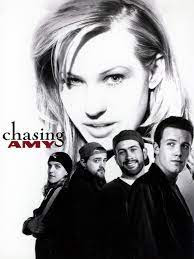
An interesting take on stereotypes and expectations around sexual identities, Chasing Amy is the third in Kevin Smith's 'New Jersey Trilogy', following on from Clerks and Mallrats. Thismeans that there are a number of scenes and bits of dialogue that acknowledge the events of the earlier films (for example, the line 'My best friend fucked a dead guy in the bathroom!' makes no sense without the viewer having first seen Clerks...) and Jay and Silent Bob feature in the films cast of characters, albeit to a much lesser extent than in the previous two films.
Set in the world of indie comix creation and conventions, our central protagonist is Holden McNeil (Ben Affleck), co-creater of the comic Bluntman and Chronic alongside his childhood friend Banky Edwards (Jason Lee). At a convention, they meet Alyssa Jones (Joey Lauren Adams), creator of Idiosyncratic Routine, who happens to be sharing a panel with their friend Hooper (Dwight Ewell), a black comic creator whose work taps into the legacy of Malcolm X and the Black Panthers. Holden is quickly attracted to Alyssa, and is excited to have the opportunity to meet up with her again (alongside Banky and Hooper) a few days later at a club. Where he finds out that she is a lesbian.
The central conceit of a straight man falling in love with a lesbian is reputed to have come from Guinevere Turner and Rose Troche's film Go Fish, in which one of the lesbian characters sleeps with a man and is then tortured by thoughts of how her community will judge her if they find out. Turner has a cameo in Chasing Amy in the nightclub scene, where she plays Alyssa's former bandmate, who persuades her to take to the stage and perform a song with the band.
While filled with Smith's usual directorial motifs, Chasing Amy is markedly different from its two predecessors, mainly because of the subject matter. If Holden and Alyssa's identities were the only ones being put under the microscope, the film wouldn't work. It is Hooper and Alyssa, the two non heterosexual characters, who seen to have the greatest self awareness and understanding of themselves and the identities they have constructed around themselves. As a highly politicised black male comic writer, Hooper is fully aware of the extent to which he suppresses his gay identity for the sake of his brand. Similarly, Alyssa knows exactly who she is, and what she wants. Holden and (especially) Banky seem rather more conflicted about their own professional and personal identities and the ways in which their relationship changes following Holden's attraction to Alyssa is at least as much of a theme of the film as Holden's relationship with Alyssa is.
This isn't just a film about sexual identities, or even rejection from communities, it's also very much a film about male fragility. Because the film was made at the tail end of the short lived cultural trend 'lesbian chic', there's also a sly flipping of the male gaze at one point. What might surprise Smith's fans is how brutal the second half of the film is, especially the ending, and this might explain why it's the least well known of the three Jersey films. It's certainly a far cry from the slapstick of Mallrats, though it does give the first indication that Smith was about to develop new themes and trends as a film maker, with his fourth film Dogma showing that he was still prepared to find humour in heavy topics.
Chasing Amy is definitely not one of Smith's most well known, or lauded, films but it's a film that has endured to a greater degree than you would expect and there are moments that are as shocking today as they were in 1997. It's a film that bears re-watching too.
A deeply flawed film that happens to include some interesting central performances, Streets Of Fire is the DVD you put on when you just want to watch something fast paced that you don't have to think about too much.
Starring Michael Paré as the brooding anti-hero/gun for hire Tom Cody (Clark Gable in cuban heels, as he's also been described...) and Diane Lane as his rock star ex-girlfriend Ellen Aim, Streets Of Fire has a somewhat ludicrous plot that unfolds much better on screen than it does in summary. As such, let's keep it brief: Ellen Aim is performing a sold out show in her home town. During the course of the show, a biker gang storm the venue, cause mayhem, and kidnap her. It's never really explained why, so we're left to assume that it's merely because gang leader Raven Shaddock (a magnificently creepy Willam Defoe) fancies her.
Reeva, a young woman who has attended the ruined show, goes home and writes a letter to her brother, Tom Cody, who - it turns out - took off to join the army many years ago but, prior to that, had been dating Ellen Aim.
Tom, having not long got out of the army, returns home, breaks up a fight at Reeva's diner, annoys the local police, and chews the fat at a local dive bar with one of his old pals... Where he meets McCoy.
I don't think the writer and director of Streets Of Fire intended McCoy (Amy Madigan) to be as much of the star of the show as she appears, but they must have had something of an inkling given that they very generously gave her all the best lines. Originally the character of McCoy (effectively Tom Cody's sidekick) was going to be a black man. This changed because Madigan basically talked them into hiring her instead. It would be fair to say that the character could easily have been played by a man or a woman, and indeed by anyone from any racial background, but that the casting of a woman in the part gives the Cody/McCoy relationship dimensions that it wouldn't have had if she'd been a man. There is no sexual attraction between the pair (which is refreshing) and this is established very early on, meaning both Cody and McCoy can concentrate on what they're in town to do: Rescue Ellen Aim from Raven's clutches.
The other central character in all of this is Ellen's manager, Billy Fish, who is played as a weaselly, money grabbing figure of fun by Rick Moranis. He's basically there to be the butt of McCoy's one liners, to annoy Cody, and be there for Ellen to come back to.
Thanks to the hard boiled characterisation, snappy dialogue, mean streets, rain, trench coats and crime element, Streets Of Fire is often talked of as being a neo noir film. This has come with hindsight, however, and back when it was released in 1984 it was tagged in the opening credits as being 'A Rock'N'Roll Fable'. Neither genre would be entirely accurate (what is a rock'n'roll fable anyway?) but it's easy to see how it would come to be seen as a neo noir, with Cody standing in for the private dick, Ellen Aim firmly in the femme fatale mode of heroine, and enough dives, grimy streets and disempowered cops to to point to as evidence. Admittedly no one had a fight with a pair of pickaxes (soundtracked magnificently by Link Ray's 'Rumble') in 1940s noir, but that's the 1980s for you.
What's perhaps more telling though is that this film was released in 1984; Two years after Blade Runner (which also has strong noirish characteristics) and the same year as Flashdance (which, um, doesn't). It shares the same post industrial bleakness of location as Blade Runner and the sexual exploitation and violence as Flashdance while existing in its own little 80s bubble. That the soundtrack is largely by Jim Steinman also ties it firmly to the 80s but, if anything, Steinman's soundtrack adds to the heightened sense of the thing, rather than detracting from it.
It's fun to watch this film for the Cody/McCoy relationship rather than the Cody/Aim relationship, mainly because the former seems more developed and rewarding than the latter. Diane Lane's performance as Ellen Aim has been criticised as wooden but her actual onstage performances are fine, it's when she's offstage that she seems miscast. This is strange given that it wasn't her first time playing a rock star: She'd played the fiery Corinne Burns in Ladies And Gentlemen, The Fabulous Stains! two years earlier, a role that seems to have had a lot more to it than her role here as Ellen.
Streets Of Fire is not a film that you watch expecting perfection; it's an implausibly plotted, rollicking ride with a surprisingly good soundtrack, great one liners, lots of high octane, highly choreographed fight scenes and an oddly satisfying conclusion. But it doesn't hold up well to forensic analysis in any sense.
This made for TV film premiered on Channel 4 in 2006 and was created by the team behind the much more well known and successful City Of Vice.
It's worth mentioning City Of Vice. Not only because it's set in the same historical period and city as A Harlot's Progress, nor simply because Henry Fielding is a key character in both productions, but because A Harlot's Progress can also be viewed as a sort of audition tape or first stab at City Of Vice.
The origins of A Harlot's Progress lie in William Hogarth's series of engravings, A Harlot's Progress, which was first published in 1732. The engravings depict the journey (or progress) of a young woman, Moll Hackabout, who arrives in London and quickly ends up being procured by one of the cities brothel madams. It is a cautionary tale and, like Hogarth's later work The Rake's Progress, doesn't end well.
The film imagines Hogarth's inspiration for The Harlot's Progress, with Toby Jones' Hogarth meeting Zoe Tapper's Moll in a tavern just as she is being procured by the brothel madam (played by an excellent Geraldine James). He draws her picture and seems intrigued by her, and by this chance meeting. Later, when she has become a high class courtesan and kept woman, Moll commissions Hogarth to paint her portrait.
Throughout the film we largely see the cruel uncaring world of eighteenth century London through Hogarth's eyes. This is a city in which children die on the streets, men can buy time with female prisoners by bribing the jailer, rich people visit Bedlam to laugh at the inmates, and there is a gin craze. One of the weaker aspects of the film is the way it tries to draw parallels between Hogarth's world and the world as it was in 2006. Sometimes this is done fairly subtly, but often it's not and it can jar the viewer a bit sometimes. Similarly, a device is sometimes used whereby the viewer enters the scene through a still that reflects one of Hogarth's six engravings for the progress, and while it's very clever, it can sometimes feel a bit Brechtian and jarring, which I'm not always sure was the intention.
There are some truly horrific moments in the film, including depictions of the later stages of syphilis, the ravages of gin, and the revelation that rather than being a lighthearted form of punishment, people did actually die in the stocks.
By contrast, Hogarth's relationship with his wife is explored and these scenes count as some of the tenderest, most touching in the film. They contrast well with the anger Hogarth feels towards the hypocrisies of those in power, particularly as regards their responsibilities to those below them in the pecking order. It is this sense of injustice that seems to have inspired A Harlot's Progress in its finished form.
There is a certain amount of fun to be had with Hogarth's interactions with his peer group, particularly Henry Fielding, who spends much of the film moping about the various public deaths of his plays. The joke here being that he will, once he switches to writing novels, receive the critical acclaim and success he has been craving. In a related note, the downward spiral of Moll is relieved of some of its brutality and horror by Hogarth's involvement in the founding of the Foundling Hospital, a purpose built home for abandoned children preserved these days as The Foundling Museum.
While A Harlot's Progress doesn't always feel perfect, it is still a well put together, compelling and thoughtful drama about a period of history that doesn't always receive the scrutiny it deserves. Both central performances are tremendous, and Jones and Tapper are well supported by other members of the cast, including Richard Wilson as Hogarth's strait laced, disapproving father in law. Well worth watching.
This made for TV film premiered on the BBC in 2013 but its origins lie much further back than that.
The Wipers Times was a trench newspaper published by The Sherwood Forresters, a troop of British soldiers stationed at Ypres during World War I (the term 'Wipers' refers to British army troops mistaken pronunciation of Ypres) who stumbled across an abandoned printing press in 1916 and decided to make use of it to start a newspaper for the troops, by the troops.
At the time, much of the British coverage of World War I was of the chest-beatingly patriotic, jingoistic nature, as perpetrated by the notorious Willam Beech Thomas (satirised in The Wipers Times as Teach Bombers) who reported (supposedly from the trenches, but much more likely from far beyond the fighting) for the Daily Mail. There is a story from the time of one of Beech Thomas' stories being stuck to one of the trenches, with the addendum 'If he comes here: Shoot him', suggesting that British troops stationed in Ypres and elsewhere had their own strong feelings about the war, and about Beech Thomas' reporting of it.
While The Wipers Times features in museum archives such as the World War I exhibition at the Imperial War Museum, and the complete run of the trench newspapers are available to buy in facsimile form as a book, the story of Captain Fred Roberts (editor) and Lieutenant Jack Pearson (sub-editor) and their wartime foray into journalism isn't well known.
Ian Hislop and Nick Newman, who wrote the script for The Wipers Times, were inspired to write the film following a short radio documentary Hislop had made about the publication for Radio 4 a number of years previously. Hislop has gone on record a number of times (including in the extras on the DVD) to say that he feels The Wipers Times is one of Private Eye's natural ancestors. The source material for the screenplay was his earlier research, alongside Roberts' memoir, and The Wipers Times itself.
Since the film was made, The Wipers Times has gone on to become an equally successful stage play, essentially making the reverse journey to that made by Oh! What A Lovely War back in the 1960s. It seems inevitable to compare The Wipers Times to Oh! What A Lovely War, given the biting satirical tone of both the soldiers songs it draws on and the articles The Wipers Times draws on. There's even a subtle mention of The Wipers Times in Oh! What A Lovely War, just as there are music hall skits and songs in The Wipers Times. Similarly, both of these productions would find common ground with the more well known Blackadder Goes Forth, which was also famously set in the trenches of WWI.
The film was shot on location in Northern Ireland, with Ben Chaplin playing Fred Roberts and Julian Rhind-Tutt playing Jack Pearson. The story begins with the Sherwood Forresters out scavenging for wood and supplies amidst the bombed out ruins of Ypres, during the course of which they discover the printing press and decide to bring it back to their trench. One of the troops, it turns out, used to be a printer and knows how to operate the machine and Roberts has the whimsical idea of starting their own publication "Like Punch, but funny".
Things go well and the publication is a big hit with the soldiers, leading to further editions and to Roberts and Pearson correcting prose and making editorial decisions amidst constant bombardment and fighting. Inevitably, not long after, the printing press is destroyed in a bombardment, leading to one of the most touching moments in the film: The troops carrying bits of decimated printing press as though they are mourning their best friend.
A new press is located, meaning it's game on so far as The Wipers Times is concerned, but the troops activities have come to the attention of the high ups, and they are (largely) not pleased.
Michael Palin puts in an exquisite turn as one of the few military commanders who, you suspect, has a bit of a soft spot for The Wipers Times and serves as a good source of support for Roberts and Pearson, just as their slightly eccentric command and compassionate attitude towards the men under their command serve as a good contrast to some of the more prim and proper military commanders.
The film, much like the original source material, doesn't shy away from the horrors of war. It also acknowledges that The Wipers Times didn't stay in Ypres, with the title changing according to where the troops were stationed. Eventually they stopped including their location in the title, for intelligence reasons, but it's known that the Sherwood Forresters were at Passchendaele and at The Somme. In the latter case, twice.
The film balances a light humorous tone with genuine pathos, poignancy and tragedy. There are also Pathé style comedy set pieces and music hall sing alongs, conveying the spirit of The Wipers Times as well as of the times.
As war films go, this is an unusual one. But it's well worth a watch.
Country of origin and year of release: India, 2004
It would be easy to write one of those elevator sell, quick summaries of Veer-Zaara:
Romeo and Juliet, but in India and Pakistan.
That summary wouldn't be inaccurate, given that the film tells the story of Veer, an Indian pilot, who rescues Zaara, a Pakistani girl, and that they do fall in love with each other. But to simply describe it as that wouldn't do it justice.
As well as telling the Veer and Zaara love story in flashback, the narrative is structured and anchored by the legal story framing it. We begin our film with Shaamiya Siddiqui, Veer's lawyer, who is played by Rani Mukherjee. She is a new young lawyer, seeking to make her mark in the male dominated Pakistani judicial system. And she has been given a case that, seemingly, she can never win: That of Veer Pratap Singh (Shahrukh Khan), an Indian man who has been detained for twenty years in Pakistan, accused of being a spy. In that time, he has refused to provide any kind of defence or explanation, or, indeed, to speak at all.
Reportedly based on real life Pakistani human rights activist Asma Jehangir, Shaamiya is pivotal to the film. It is she who persuades Veer to tell her his and (by extension) Zaara's story, and it is she who fights to change minds, to bring a case to challenge his imprisonment.
The tense legal scenes are intercut with vivid Bollywood recollections from Veer of his romance with Zaara (Preity Zinta), which are relayed in luminous scenes that show both the Indian countryside and Pakistan's cities at their best. Veer, we discover, grew up in a small village but went on to do very well when he qualified as an Air Force pilot, rescuing those in need. Zaara, meanwhile, grew up in wealth and pampered luxury in Lahore. They could never be together. Not just because of their two countries relationships with each other, but because - in the case of Zaara - her fate was already sealed.
As I suspect is the case with Bollywood films in general, there is a real sense of spectacle to Veer-Zaara. I felt something of this spectacle, and sense of scale, years ago when I first saw the equally good Monsoon Wedding, but I'd say that Veer-Zaara is probably closer to my western sense of Bollywood. Mainly because it features characters bursting into song on a regular basis and Monsoon Wedding doesn't, but also because it's so incredibly long. It is, to date, the only film I own on DVD that includes an intermission. It is so long that it makes Gone With The Wind look like a taut 90 minute drama in comparison. You really need to be prepared to set aside an entire afternoon or evening for it. And to have a huge box of tissues to hand.
What makes the film such compelling viewing is the engaging performances from the two leads as well as strong support from Mukherjee as Shaamiya and Divya Dutta as Zaara's friend and confident. The cinematography is also, frankly, gorgeous. What also makes it is the sense of Zaara we get through Veer's re-telling of their story: The Zaara he portrays is rebellious and outspoken, not given to sitting at home and waiting for her life to start. Through his telling, the viewer gets a real sense of not only his character but hers, and why he loves her.
Adapted from Truman Capote's novella of the same name, it feels only fair to state at the outset that Breakfast At Tiffanys the film is a very different beast to Breakfast At Tiffanys the novella. Both are equally enjoyable, but for different reasons.
Given the gritty reality of Capote's Holly Golightly, and her world, it perhaps doesn't seem surprising that the author had very clear ideas about who he wanted to play her. And it wasn't Audrey Hepburn.
Instead, Capote's stated preference is widely reported to have been Marilyn Monroe, an actor whose background and biography would have placed her closer to the reality of a female hustler such as Holly.
Hepburn is perfect (nay iconic) as the Hollywood version of Holly Golightly, but that Hollywood version is, alas, a Holly defined and restricted by the expectations of Hollywood and the confines of the Hays Code. Which is a long way of saying that the character is much nicer, and is more appealing, in the film than she is in the book. Similarly, it's never really clear in the film just where she's getting her money from, and the screen version features a traditional Hollywood ending that certainly isn't in the book.
The film begins with George Peppard's character, Paul, moving into a New York brownstone and meeting his neighbour, the charming Holly Golightly, an adventurer with a series of male friends who holds loud parties and keeps him awake at night. He first meets her properly when she climbs in through his open window from the fire escape in order to escape from the man she's left downstairs in her apartment.
Later, he is invited to a party at her apartment, and the viewer witnesses one of the most entertaining moments of the whole film in the form of a hedonistic, cigarette and alcohol fuelled post war blitzkrieg that only ends when the police are called. It's a vision of a bygone world and, for this reason alone, you should watch this film.
In the film Paul is definitely heterosexual, meaning that the story can take a more romantic turn than Capote's original story did. Rather than being simply fascinated by his neighbour, Paul is now free to fall in love with her, and can be seen to be acting out of a sense of love and chivalry rather than simply friendship. Their relationship is also complicated on screen by the presence of Patricia Neal's character, a distinguished older married woman who has some kind of interest in Paul that the viewer guesses at rather than knows for certain. As with Holly's men, we kind of know where her interest in Paul lies, but it's never made explicit within the film. What it does is place them on a more even footing as characters: He may have a more comfortable life than her but, ultimately, are they so different? Seems to be the question that is being asked.
Hepburn's Holly is an irresistible mix of charm, chic and exuberance that carries the film but - Mickey Rooney's disastrous casting aside - this is a film in which nobody is bad and everyone, however small their part, turns in an excellent performance. A case in point would be Dorothy Whitney as Mag Wildwood, who embodies the part perfectly, being both very funny and also true to what you suspect would be Capote's vision of her. Similarly, Neal - playing a character written for the film - purrs and vamps her way through every scene and Martin Balsam, as Holly's agent, is perfect in this cigar chomping, fast talking character part.
The element of the story that adds the most pathos has always been Holly's aspect of little girl lost vulnerability and (implied) mental instability, both of which Hepburn nails completely. And it is for this reason that the romantic aspect of the film works so well, up to and including the ending. We can believe that Holly would lay aside her adventures for the right man because the Hollywood version of her, er, would. Similarly, the Hollywood version would also go back and find the cat that she's just abandoned and would have a happy ever after ending with Paul. And, really, there's nothing wrong with that.
While rightly cited as a film noir classic, The Big Sleep has nonetheless regularly been criticised for having an unfathomable plot. Adapted from the Raymond Chandler novel of the same name, The Big Sleep was the first of Chandler's novels to feature detective Phillip Marlowe.
Starring Humphrey Bogart as Marlowe and Lauren Bacall as Vivian Regan, the elder of General Sternwood's two wild daughters, this film was the second pairing of Bogie and Bacall, following on from To Have And Have Not two years earlier.It's widely reported that the minimising of Martha Vickers role as Carmen Sternwood, the younger of the two sisters, was as a direct result of the chemistry between Bogart and Bacall. It might also be for this reason that the end of the film is ever so slightly tweaked, giving it a more sentimental, romantic feel than was the case with the book. Overall though, this is a faithful adaptation of Chandler's novel.
The story begins with Marlowe paying a call on a prospective client, the afore mentioned General Sternwood. In the course of his visit he also meets the giggling Carmen Sternwood, who makes something of a play for him, and discovers that General Sternwood is being blackmailed... again. Then there is the matter of Sean Regan, husband to Vivian and a protegee of the General, who has disappeared.
Part of the reason why the plot can be regarded as confusing (and one of the reasons why the film repays repeated viewing) is because there isn't just one plot. There's at least two, possibly three or four, and they interact with and entwine each other in a series of increasingly confusing ways that it can be very hard to keep track of. But... it almost doesn't matter. The fact that it constantly keeps you guessing is a key part of the film's charm, that and it's incredible sense of tension.
There's a particular scene in which Marlowe is in an apartment trying to interview a witness, only to be interrupted by a knock at the door and the entrance of a semi deranged already established character. Once that person has been got rid of, Marlowe resumes his investigation, but there is another knock at the door... and you feel a real shiver down the spine from the sense of impending doom that this moment brings.
Similarly, the script (and its source material) is so well crafted and developed that even minor characters are vivid enough for you to find yourself caring disproportionately about what happens to them.
Part of the fascination of film noir comes from watching the ways in which film had to find ways to negotiate the censorship self-imposed on Hollywood by the Hays code. How to navigate a swamp of violence and vice without breaching the moral standards Hollywood had chosen to impose on itself (at least on screen). You can see that tension in a noir classic such as Double Indemnity, not just because the crime is punished, but also in the language used between hero and femme fatale, and by what is shown and not shown. Similarly, there are aspects of noir that might seem weirder, or more shocking, today then they perhaps would have done at the time: The fascist collaboration that runs as an undercurrent beneath Gilda (the misogyny is, sadly, more of a given), the wilful disregard for preserving crime scenes (pretty much any noir, but especially, especially Laura, in which Dana Andrews cheerfully traipses all over the titular heroines home, and practically moves in, for a good fortnight or more) and the overall sense in which the spectre of World War II hangs over these films (most of them, but Witness For The Prosecution is a good tangible example of this.)
These are not nice stories; because these were not nice times. Discussions and debates around the representation of men and women in noir are well established, and are no doubt better, and more thoroughly discussed, elsewhere but it is worth noting that it was the 1944 psychological thriller Gas Light that gave us the phrase gaslighting and that, while not regarded as a noir, it was released a mere two years before The Big Sleep.
As for gender roles within The Big Sleep, Chandler's Marlowe tends to adhere to his own code as regards how he treats people, meaning that the women in Chandler books and their many adaptations tend not to come off as badly in terms of fate and characterisation as they might have done elsewhere at the time. Marlowe is a likeable guy; not a Peter Whimsey by any means, but certainly not an arsehole. More a lightly tarnished type than a full scale knight in shining armour: "Marlowe; the shop soiled Galahad" as a doctor in The High Window puts it. Similarly, Chandler's men and women tend to be a mixture of the good and the bad: Marlowe doesn't think much of either of the Sternwood women, but he comes to feel something (albeit something rather complex) for Vivian and doesn't seem to find it in himself to despise the exasperating Carmen. Indeed, for much of the film, he finds himself running around after and rescuing both of them to varying degrees. Similarly, there is a murder that takes place in the film that affects him more than any of the others and, with the viewer watching events unfold through his eyes, it's easy to see why.
The Big Sleep wasn't Marlowe's first on screen appearance, in fact you can find out more about the various ways in which the Phillip Marlowe stories were used and abused by Hollywood over on Tor.com, but it was the first - and only - time that he was played by Bogart. I haven't seen any of the other screen adaptations of Chandler's work so I can't comment on how well The Big Sleep compares to the on screen adaptation of Farewell My Lovely (another Marlowe classic), which was released under the title Murder, My Sweet in 1944. I would say that those two (and perhaps The Long Goodbye) are my favourite Marlowe stories though, so I suspect Murder, My Sweet would be worth checking out.
This is one of those films where you find yourself thinking "Surely it can't possibly be as good as the trailer?"
But it so is.
I suspect that Amirpour's art house feminist vampire western hybrid, which also nods to 1950s Hollywood and James Dean films, is going to be the film for which my abilities as a would-be film blogger will be the most stretched and tested: It's quite possible that I will come spectacularly unstuck in the process. With that in mind, I feel very comforted by the fact that the always reliable Mark Kermode has written one of his most elegant salutes to A Girl Walks Home Alone At Night, which you can read here. As such, I feel I have a safety blanket to cling to should I need it.
It's easy to feel intimidated about writing about A Girl Walks Home Alone At Night. Mainly because it's so bloody good, but also because it successfully juggles three film genres that I'm not entirely familiar with and because it's set in a fictional Iranian lawless ghost town and the anti-heroine is a skateboarding, chador wearing avenging vampire. It's also entirely in Persian, but I feel that subtitles are less of a reason to be intimidated.
The tellingly named Bad City is a stark wasteland and the sense of desperation and foreboding is enhanced by Amirpour's decision to film in black and white. Bad City has the same sense of bleakness and brutality as the favelas of Fernando Meirelles and Kátia Lund'sCity Of God, but without the cheerful bits. Bad City is a place where young men have their cars repossessed to pay their fathers drug debts, where sex workers are menaced by pimps and forcibly injected with heroin, and where opportunity and fun are extremely hard to come by. It is, as Kermode acknowledges, a place sorely in need of an avenging angel. "What catches everyone off guard is that this avenging angel should take the form of Sheila Vand."
Vand as The Girl both imbues the image of the chador clad muslim girl with a sense of predatory menace and subverts existing stereotypes of muslim womanhood not only by casting her as the predator rather than the preyed upon, but by having her use her seemingly demure Islamic womanhood as a lure to draw in and capture various predatory men. As a character it's striking just how little dialogue she has in a film that is notably sparse in dialogue.
By contrast, Arash Marandi, styled here as the central male protagonist (The Boy) in the form of "The Persian James Dean", fulfils the role of would be love interest for The Girl, but also someone to be protected by her. She first encounters him in a distressed state on his way home from a party at which his privileged would be lover has given him sparse attention. He is disorientated and vulnerable, dressed as Dracula and, ironically, in need of rescuing by this most unlikely of rescuers.
There follows a series of intensely awkward encounters between the pair, notable for their tenderness amidst the brutality of life in Bad City and the many, many killings.
As visually distinctive as Amirpour's film is, it's also got an equally distinctive soundtrack which features everything from 80s electro to modern indie rock, eastern dance music and the western soundtrack music. A Girl Walks Home Alone At Night has all the hallmarks of a classic, but I think it's still - alas - more of a cult film at present.
Country of origin and year of release: South Korea, 2008
Adapted from a Japanese manga, Antique Bakery tells the story of wealthy, privileged Jin-hyeok (Ju Ji-hoon) who, after having led something of a playboy lifestyle for much of his young life, announces to his family that he intends to settle down by opening a cake shop. His reasoning? Women like cakes, therefore he'll be able to meet lots of girls.
As you might expect, his reason for wanting to open a cake shop isn't as straight forward as all that. The audience is given to understand, very early on, that something terrible and traumatic happened to him as a young child. We don't know exactly what but the scene in which he violently vomits up the cake made by his patisserie chef, and the flashback to his adolescence, in which he equally violently rejects the clumsily expressed love of school boy Min Seon-woo (Kim Jae-wook) offer some kind of clue. He is, at least initially, and to some extent throughout the film, an obnoxious character, but he's also compelling and sympathetic in his quest to understand how he ended up the way he is. In the depiction of this central character and in the other three central characters in this film, Min Kyu-dong doesn't shy away from depicting male fragility and vulnerability alongside male bravado and machismo.
Min Seon-woo, Jin-hyeok's spurned schoolmate, is recruited by him as a patisserie chef and - despite having bounced back more than admirably following his crushing rejection by Jin-hyeok - his love god status contrasts with the blowback from some of his more impulsive sexual decisions. This has led to a certain amount of criticism for the film in that Min Seon-woo is proclaimed as "A gay of demonic charm" who can quite literally charm the pants off any man, suggesting the stereotype of the sexually promiscuous, predatory gay man.
Due to the wider complexities of Min Seon-woo's character, which quickly become apparent, I feel that the stereotype is exploited rather than confirmed to. Min Seon-woo might be enjoying an extremely robust sex life, but he's also regularly sacked from his various chef jobs, leaving behind him a trail of inconsolable kitchen staff who have fallen in love with him. While Min Seon-woo's sexual magnetism is largely played for laughs, it is also used to make important points: He was subjected to a volley of homophobic verbal abuse by Jin-hyeok when he made his clumsy confession of love and, rather than go home and cry about it, he instead went to a gay bar, got shitfaced, and had an epiphany that he didn't have to be another kind of gay stereotype: Emotionally tortured, alone, and isolated.
The baby faced ex boxer Yang Ki-beom (Yoo Ah-In) soon joins the cake shop, Antique, as a cake obsessed trainee patisserie, under the watchful eye of Min Seon-woo. While he initially presents as a cheeky, greedy, brat it becomes apparent, following a confrontation with a customer, that he too has secrets he would rather not talk about.
While the overall mood of Antique Bakery is often as light as the patisserie, verging on camp at times, it does - as I've already hinted - have a series of darker undertones. Central to this is an unfolding crime story that at first seems to have little to do with the antics at Antique but which, in the end, becomes firmly entwined with that establishment and its staff.
We know that there is something lurking in Jin-hyeok's past that he clearly needs to deal with, and we know that it is tied up in some way with the constant presence of the fourth member of staff at Antique: Nam Su-yeong (Choi Ji-ho), a clumsy young man and supposed childhood friend of Jin-hyeok, who also appears to serve as his bodyguard. But who, or what, is being protected? And from whom?
While it has been said that the plot doesn't quite work, I'd say instead that this is a film that needs to be watched more than once. Not only will it make more sense on the second viewing but you will also take different things from it, and notice different things. For this is a film that improves with repeated viewing.
Kyôko Fukada and Anna Tsuchiya as Momoko and Ichigo
Director: Tetsuya Nakashima
Country of origin and year of release: Japan, 2004
Adapted from Novala Takemoto's novel, and known in Japan as Shimotsuma Story, Kamikaze Girls has been justly recognised as one of the main cultural channels for the popularisation of Japanese street fashions abroad, particularly the Lolita fashion trend.
In this fast paced, inventively structured, vivid screwball comedy/female buddy movie, we are introduced to Momoko; a demure, dutiful, Rococco obsessed Lolita, and Ichigo; a loud, aggressive, gobbing motorbike obsessed Yanki. As fully paid up members of their respective fashion tribes, they should, by rights, have nothing to do with each other but - given that they live in the remote, rural rice paddy field dominated town of Shimotsuma in Ibaraki Prefecture - they are thrown together by virtue of being The Only Weirdos In The Village.
Momoko, we know from the start, had very different beginnings: The result of an inelegant, drunken one night stand between a night club hostess and a hopeless aspiring yakuza in a decidedly more gritty, gangster orientated town, she fell in love with Lolita fashions following a trip to the famous Baby The Stars Shine Bright boutique in the hippest part of Tokyo. Her evolving Lolita look was equally as at odds with the fashion trends in her hometown ("It was tracksuit country") as they are with the credulous locals in Shimotsuma, the quiet town she and her father are forced to flee to following his over ambitious adventures as a fashion counterfeiter.
She meets Ichigo when, in an attempt to raise funds to feed her fashion habit, she begins quietly selling her fathers counterfeit Versace clothes. The two fail to hit it off and yet Ichigo returns, again and again, and attempts to befriend the aloof Lolita. Momoko, being more interested in Rococco France and embroidery, cannot understand why Ichigo keeps on coming back but it slowly becomes apparent to the audience, if not to Momoko, that Ichigo - despite her posturing - is, at heart, a friendly girl who has seen something in this curiously attired fellow misfit that she likes and admires.
There follows a series of adventures involving Pachinko, embroidery, an unusually coiffed gangster, an odyssey to Tokyo's ultra hip Daikanyama district, and the entrusting of Ichigo's beloved Kamikaze coat (synonomous with her all girl biker gang tribe, The Ponytails) to Momoko. Somewhere along the way, a friendship is formed, and new loyalties and priorities develop, leading to difficult choices.
One of the reasons why Kamikaze Girls is such a great watch is its penchant for breaking the fourth wall and messing with narrative structures. When Momoko feels the narrative might be getting a bit slow for the viewer, or there's going to be some backstory coming up, she often turns to camera and signposts the incoming hand break turn. Examples would include the story of her father being told in the form of a short tragi-comic documentary which is shown, to much hilarity, on a TV screen in the station waiting room as she awaits her train. Similarly, Ichigos back story is relayed in a helpful summary, voiced by Momoko, and there is even a short animation detailing the recent history of Ibaraki's girl biker gangs, shown as an intermission feature while Momoko and Ichigo are dining out at the unfeasibly named Forest of the Aristocrats.
Despite her singularly lone wolf, hard boiled, independent character, Momoko is an oddly likeable character. Even when she's being bad, she's selfish rather than awful, and the final selfless act she commits to at the films climax is - while out of character - a choice that the viewer can fully support.
Similarly, while Tsuchiya's performance as Ichigo often feels over the top, it works because both she and Fukada are playing flamboyantly cartoonish stereotypes that they then, over the course of the film, imbue with humanity, complexity and likability.
Somewhere in the hectic, technicolour joyride that follows, a very likeable screwball comedy emerges.
Country of origin and year of release: Japan, 1994
Pom Poko features, at its heart, an environmental and conservation theme that is common to a number of Studio Ghibli productions, most notably the excellent Princess Mononoke. You can also see nods to it in Nausica, My Neighbour Totoro and Whisper Of The Heart, amongst others.
It is best characterised as a nostalgia for pre-industrial age Japan, conveyed through a gentler way of life, and a sense of harmony with nature, often depicted in the form of wood spirits and similar creatures. On the other hand, nature is often shown to be untamable and unpredictable, while still needing protection. Often, as is the case with Princess Mononoke, there is depicted the ultimate destruction of nature, and a sense of intense sorrow and grief at that destruction.
In Pom Poko, the reason for this reoccurring theme quickly becomes apparent: The film takes place in the 1960s, at a time when Japan's industrial boom saw rapid industrialisation spread from cities such as Tokyo to the nearby countryside.
Much as Richard Adams Watership Down sought to depict the tragedy of rapid industrial growth at the expense of the environment through the eyes of rabbits, so Pom Poko tells the story of a similar tragedy through the eyes of raccoons. Like Adams' rabbits, their territory and homes are being destroyed by industrialisation but, unlike the rabbits, the raccoons elect to stay and fight. Specifically, through a number of schemes, they try to chase away the humans, to make them give up and let them stay on the land in peace. It is fair to say that it doesn't end well.
As with Watership Down, there are mystical elements to the story, and - to a certain extent - collaboration and assistance with other animal species. There is also the game changing element that is the raccoon's ability to transform themselves into humans.
Like a lot of Studio Ghibli, it's a film that is by turns funny and very sad. It also has an epic fantasy feel to the narrative that at times feels as though it might escape the confines of the story, but which it never does. In the raccoons story we see a tale that feels all too human in many ways, dealing as it does with themes such as unexpected and unwelcome change, things outside of our control, and grief. It is utterly absorbing.
In this frankly mind boggling film, Zack Snyder - a man more known for superhero and zombie films than for psychological thrillers - applies the styles, codes and conventions of the superhero film to what can only be described as a 21st Century take on the Victorian era incarceration of difficult women and girls story. Think Avengers meets The Woman In White.
It only just comes off and the main reason it works is because Snyder applies the same superhero action codes and conventions to the modern day incarceration of difficult girl protagonist bit of the plot as he does to the fantasy sequences, meaning the whole thing is incredibly high octane, over the top, and stylised to the hilt from the minute the film opens.
Baby Doll (all the characters have names like this - you just have to go with it...) has just lost her mother, has been abused by her stepfather (who, it is implied, was probably complicit in her mothers death) and has accidentally shot and killed the younger sister she was trying to protect from said stepfather. In shock, she is driven to a suitably gothic looking hospital where she is drugged, money changes hands, and she is admitted as a patient, having been declared insane. This all happens in the first five minutes.
Once inside the hospital, she finds herself performing menial work alongside a group of other young women who - like her - seem as sane as the next person.
Then, it gets weird.
Instead of finding ourselves in One Flew Over The Cuckoo's Nest territory, our heroine instead finds herself in some high stakes version of Moulan Rouge.
No, I still don't get that bit either.
Anyway, suspend your disbelief and strap in for the ride because it's about to get weirder still.
When Baby Doll is forced to dance for the various sleazy blokes who pay to be entertained by the mental hospital patients, she goes on a journey inside her head to make it bearable, taking the viewer with her.
In her head, she goes on a series of quests, in which she needs to face various perils and defeat various foes in order to retrieve the items she and the other girls will need in order to escape the hospital. Initially she is fighting alone but, as she persuades the other inmates to help her, they also join her in her fantasy adventures. There's a standard samurai fantasy to begin with, then later a steampunk take on WWII, then a high stakes explosives on a train task. Not all of the quests occur without costs, and the reality behind the fantasy is often hard to take, especially when it goes wrong.
On one level, you have to admire the sheer audacity of the plot, but there are aspects of it that do feel a bit queasy. There is the essential incarcerations of difficult women plot, and how it plays out, up to and including the way in which toxic masculinity, itself a form of madness, is allowed to roam unfettered within the hospital. There are many victims here, and the film skips lightly over a number of the many deaths that occur. Similarly, its very much up to the viewer to decide if the female characters are purely there to be viewed as sex objects by the viewer, as much as by the men who pay to exploit them within the film, or if they are fully rounded characters who, while exploited, are given agency and heroic characteristics. It is hard to form a consensus on that.
Perhaps the most troubling aspect of the film, or simply the moment when it lapses into poor taste, is the closing credits sequence. We have, quite literally, watched a man run rampant through an entire enclosed community, terrorising, exploiting, killing and profiting from multiple women. He has even forged signatures and caused medical procedures to take place illegally on a number of patients. How then is it OK to have that character dancing and lip syncing with the doctor, who he has undermined and taken advantage of professionally and (possibly) personally throughout the film as though this was a comedy? What The Actual Fuck?! As the young people say.
I have watched Sucker Punch about three or four times now, and every time the closing credits sequence has felt like a slap in the face. I think it's because, without it, the film would make a kind of sense and have a sense of resolution, however harrowing, but with it... it feels like the sucker punch of the films title.
Sucker Punch is a film that does benefit from being watched more than once, and it does have a lot of style, a great soundtrack, cleverly executed and beautifully filmed moments within the narrative, as well as interesting things to say about power, control and madness. But it's fair to say that any aspect of the film that troubles you on the first watch will most likely still trouble you on future watches.
I would never have encountered Girl (which has the feel of a straight-to-video release) had it not been for regularly watching it's trailer on a long forgotten VHS tape. I was intrigued by the films seemingly slapstick take on the 1990s grunge scene, and the perennial teenage coming of age film structure holding it all together.
Starring a post-Lolita Dominique Swain, Girl tells the story of Andrea Marr, a fairly quiet, strait-laced much loved only child of older, very over protective parents. Undistinguished and largely unnoticed at high school, Andrea is, in short, A Geek.
That is until she meets Todd Sparrow (Sean Patrick Flanery), singer in local grunge band The Colour Green (surely a choice that would be firmly at the bottom of anyone's band name list, but still...), and develops such a severe crush on him that it borders on stalking. Her bass playing friend Cybil (Tara Reid) is unsurprisingly cynical about Andrea's sudden transformation from geek to aspiring grunge queen, and Andrea's (admittedly boring) friend Darcy (Selma Blair) is abandoned with little thought or consequence. Andrea's entree into the local grunge scene comes from Rebecca (Summer Phoenix), a lone grunge girl in her class at school, who knows all the cool bands and all the best venues, and essentially takes the unworldly Andrea in hand. On her way to snagging the weirdly uncharismatic Todd, Andrea falls into the path of Kevin (Channon Roe), a journalism student who provides her with her first (deeply unsatisfying) sexual experience. She also meets Todd's sister, Carla (Portia de Rossi), an effortlessly cool grunge queen who tells Andrea straight up that Todd is not for her: "You're too good for him; he doesn't deserve a girl like you."
This grunge story has its roots in a serialised story of the same name, which first appeared in Sassy magazine before being published as a novel in 1994. The book's writer, Blake Nelson, later adapted the novel for screen, during which process the previously un-academic and un-motivated Andrea suddenly became Ivy League material, giving the inevitable relationship with Todd an extra layer of built in destruction that greatly enhances the plot.
Although the book Girl was written prior to cult US coming of age series My So-Called Life, the film Girl compares unfavourably to Winnie Holtzman's series. Tara Reid's Cybil is no Rayanne Graff and Swain's Andrea Marr is no Angela Chase. And yet the film does have some genuinely funny moments:
A post coital and confused Andrea visiting the school counsellor's office to try and make sense of her first sexual encounter with Todd Sparrow is one, as is the first gig scene, which quite rightly eschews realism for atmosphere and comes away with a clumsy sense of charm in the process. In a related note, Summer Phoenix as Rebecca gets most of the best lines, including her introductory speech in which she accurately skewers musical sub genre snobbery.
There are some interesting performances here, including de Rossi as the effortlessly cool Carla, and the aforementioned Phoenix as Rebecca, who would have made a much more interesting lead character than Swain's Andrea.
Swain herself has a tendency to come across as whiney at moments when the viewer is meant to feel sympathy for her, but Reid as Cybil is at least periodically interesting in her performance, and Blair as the abandoned Darcy is... OK. Sadly, pretty much all of the male characters, up to and including Todd and Kevin, feel woefully underwritten.
It would be an interesting 'What if?' to imagine what Girl would have been like had Phoenix's Rebecca been the lead character instead of Swain's Andrea. It would have made for a very different film, especially as Rebecca would have been far less likely to put up with Kevin's pseudo intellectual music journalist bollocks, and probably would have been clear headed enough, and had enough self esteem, to stay away from Todd Sparrow. It's unlikely that Hollywood would have been interested in that story though, and the result would probably have been closer to Daria than My So-Called Life, which would have been no bad thing.
Even at the time, Gus Van Sant's adaptation of Tom Robbins cult novel Even Cowgirls Get The Blues seems to have upset people. Mainly, it seems, for the unforgivable sin of not being My Own Private Idaho.
There are always going to be problems with managing expectation when it comes to adapting a well loved book, especially one that was structured in such a way that adapting it for screen would be a challenge. But these problems were clearly added to by the success of the aforementioned Van Sant directed My Own Private Idaho three years earlier.
Like MOPI, ECGTB features a member of the Phoenix clan. Rain in this case, not River, who had died the year prior to this films release. I'm not sure whether this raised expectations or not, but the many perceived failings of ECGTB cannot be laid at Rain Phoenix's feet as she is clearly playing a blinder as the teenage cowgirl Bonanza Jellybean, love interest to Uma Thurman's hitch hiking model Sissy Hankshaw.
Robbin's presumably didn't take too much issue with what Van Sant did to his book as he appears as the narrater, but there are clear differences between book and film, including the cutting of almost all of the plot involving Julian Gitche (played by a much underused Keanu Reeves). Like the book, the film is fairly all over the place, meandering here and there at a gentle, picturesque pace that reflects its origins in the counterculture of the 1970s. There are aspects of the story that wouldn't stand scrutiny today, including a self proclaimed mystic to the counter culture known only as The Chink (played by Pat Morita).
When taken in the context of the mid 1990s, the film was refreshing for providing rare portrayals of LGBT+ characters; from the bi curious rich bohemian set who attempt to seduce Sissy into a threesome following her disastrous first meeting with Julian, to John Hurt's majestic The Countess, not to mention the all-female community of the cowgirls. As with the depictions of the counterculture though, it's likely that viewers opinions of these characters, and their motives, will have changed since the book was written and the film was made. None the least because the depictions of trans and lesbian characters in the book and the film were constructed in entirely different cultural contexts than today.
Aside from this wider point about representation, there are some genuinely good performances in the film: The aforementioned Rain Phoenix, who brings a cheeky exuberance to her portrayal of Jellybean, but also - perhaps surprisingly - Roseanne Arnold in an hilarious cameo as a the fortune teller Madame Zoe, who is faced with the unenviable task of telling the child Sissy's increasingly desperate mother that Everything Is Going To Be OK. When faced with the child's unfeasibly large thumbs, she breaks character and exclaims in horror "Jesus fucking Christ..."
"A husband" mutters Sissy's mother, frantically pushing wads of money towards Madame Zoe, "Is she going to find a husband?"
Zoe, knowing which side her bread is buttered, draws herself up into a suitably mystic trance. "I see men in your life" she says brightly, looking over at the young girl "I also see... women: Lots and lots of women"
At which point Sissy's horrified mother drags the wide eyed child out of the fortune telling booth.
The grown up Sissy, aided by her large thumbs, takes to hitchhiking like the proverbial duck to water, living exclusively on the road and treating it as a way of life. She is talent spotted by The Countess, who hires her as a model to pedal his vaginal douches and other feminine hygiene products, recognising in the unworldly Sissy the perfect ingenue.
As the role of The Chink suggests, there were elements of the 1970s counter culture that might feel more troubling today than they would have done at the time. As well as the personality cults of the 1970s, this character also shows the hippies fetishisation of other cultures, just as Sissy's interest in the Native American community hints at a possible, more well intentioned, fetishisation as well as America's deeply troubled and problematic relationship with that community. Similarly, it's fair to say that the past is a different country when it comes to attitudes to women, and that the counterculture's attitude towards women no longer seems as forward thinking as it was portrayed at the time.
This is by no means a perfect film. It is deeply flawed in a number of ways, and at a number of levels, and yet it is a film that you can return to and find new things in. As well as Phoenix's performance, we also have some fantastically over the top scenery chewing scenes from Lorraine Bracco as Delores Del Ruby, the cowgirls peyote guzzling seer. Thurman's own performance is less good, but it's not as terrible as it's sometimes portrayed. Arguably, she can do comedy, but the role of Sissy Hankshaw falls somewhere between comedy and drama, and it's for this reason, and because of the overall strangeness of the films narrative in general, that she struggles a bit.
Country of origin and year of release: Japan, 1995
Perhaps not one of the best known Studio Ghibli films, Whisper Of The Heart (adapted from Aoi Hiiragi's 1989 manga of the same name) tells the story of fourteen year old Shizuku Tsukishima, a book loving, library haunting girl with a clearly established love of reading and highly developed imagination.
Over the course of the summer holidays, she becomes fascinated by the identity of the mysterious Seiji Amasawa, whose name keeps appearing in the list of borrowers for every library book she takes out.*
At the same time, she is becoming increasingly irked by her repeated chance encounters with a rude and sardonic boy of the same age, who always seems to meet her at her worst: Forgetting her dad's lunch box, leaving her lyrical re-working of John Denver's 'Take Me Home Country Road' on a park bench...
Inevitably, he turns out to be Seiji Amasawa.
While clearly written as a coming of age story of friendship and first love, Whisper Of The Heart is a beautiful anime not just because of the vividly evocative quality of the animation, nor even because of the central coming of age/romance storyline. It's beautiful for the way it celebrates the value of reading and imagination, and the importance of following your dreams: Shizuku and Seiji want different things. He wants to be a violin maker, she wants to be a writer and when Seiji gets the chance to travel to Cromona in Italy to try out as an apprentice, Shizuku is inspired by his dedication to attempt to write her first novel. It is not an unqualified success, but then neither is Seiji's visit to Cromona. What's important is that they tried, and that they both learnt something.
Equally as important are minor characters, such as Shizuku's best friend Yuki and Sugimura, a sports loving boy known to Shizuku, who Yuki has a crush on. One of the most affecting scenes concerns the discovery of an unwitting love triangle between these three characters.
There is also the mysterious cat statue, the Baron, owned by Seiji's uncle, whose story inspires Shizuku's literary efforts. The character of the Baron, along with the train travelling, dog baiting, cat Muta, would later return in the aptly titled The Cat Returns in 2002.
Whisper Of The Heart is a sweet film which isn't overly sentimental, and which is complex and well developed enough to be compelling watching for all ages. Younger viewers will enjoy the cats, older viewers will be reminded of their own teenage dreams and aspirations, as well as the pangs and pains of first love.
*Sadly a pleasure that was surely lost as soon as library management systems became computerised in the 1990s
As the extra features on the DVD make clear, the origin for this film came from a documentary about ice skating that screenwriter Steve Rogers watched. The documentary mentioned the former US figure skater Tonya Harding and Rogers was suitably interested in her story to meet and interview her and her ex husband Jeff Gilhooly. Both Harding and Gilhooly gave completely contradictory accounts of pretty much everything, including the infamous incident that ended Harding's career in 1994. It is this pair of entirely contradictory interviews that inspired the multi person perspective 'mockumentary' style and structure of the film. Given the perceived unreliable nature of their testimony, it seemed best to lay everything down on screen and let the viewers draw their own conclusions about who was sinning, who was sinned against, and what really happened.
Harding was banned for life from competing by the United States Figure Skating Association following an attack on her rival, Nancy Kerrigan, just ahead of them both competing in the 1994 Winter Olympics.
I am old enough to remember the attack on Kerrigan, also how it was reported in the international media. This was a BIG STORY, coming as it did right before both women competed in the 1994 Winter Olympics. As well as the interviews with Kerrigan and Harding in the aftermath of the incident, I also remember watching footage of both women competing. Watching it all unfold on the TV news as a 15 year old, I can remember at once how surreal and weird the whole thing felt: Ice skating? Assault?!? But also how quickly scrutiny and suspicion seemed to fall on Kerrigan's team mate, Harding, whose rough diamond, working class image was both immediately apparent in interviews just as it was clearly being positioned as being directly at odds with the highly polished femininity of Kerrigan. Something was off about Harding, all of the coverage seemed to be suggesting: She had a hard manner and slightly aggressive sounding way of talking, which didn't do her any favours in this situation, and her heavy makeup contrasted sharply with the soft, princess-like image of Kerrigan and other skaters. As the international news coverage at the time, and I, Tonya itself shows, there were reasons why people wanted to see Harding fall. And it wasn't because she was heavy on the rouge.
The film itself helps to fill in some of the gaps when it comes to establishing the back story of Harding, including who she is, why she is, and why things unfolded as they did. There are a lot of strange characters in the film, but perhaps the most memorable and most defining character is Harding's mother LaVona Golden, as played by the excellent Allison Janney. Janney quite rightly won Best Supporting Actress award at the 2017 Academy Awards for a performance that is as absorbing as it is terrifying.
Throughout the film, viewers must decide for themselves what does and doesn't seem accurate, as well as who might not be telling the truth. This applies to Harding's entire biography, including her childhood, skating career, and marriage to Gilhooly, not just to what happened to Kerrigan. Was LaVona an abusive mother? Did Jeff beat Tonya? Did she fire a gun at him? It makes for gritty, unflinchingly violent at times viewing, but one thing the film doesn't do is let up in pace.
Not everyone was happy to see a film being made about Tonya Harding, a woman who seems to divide opinion in the US as strongly now as she did back in 1994. One is reminded, weirdly, of Amy Fisher, whose own crime and punishment took place around the same time. Viewing both women, and their respective crimes and monstering by the US media, from both a different continent and a historical remove, it's hard not to feel that their stories were considerably less black and white than they were portrayed at the time.
Margot Robbie's depiction of Harding is that of a rough diamond, but she is far from lovable. While the film, to some extent, falls into the strong woman trope, it is complicated by how unlikeable Harding is as a character at certain points. There are times when the audience has sympathy for her, including when she appears to be being penalised by successive judges in figure skating for not being middle class, feminine and submissive. At the same time, she is clearly a highly volatile character, given to violent rages and self sabotage. It is up to the audience to decide how much LaVona made Tonya who she is, and how much Tonya brought things upon herself.
Overall, there is much to recommend I, Tonya, including the fact that it's a film that both challenges the audience and stays with you long after viewing. It is a hard watch at times, but its also an absorbing one.
Adapted from the book Molly's Game, the memoir of 'poker princess' Molly Bloom who successfully ran a gambling empire in Los Angeles and New York before being charged by the FBI for reasons not entirely to do with poker. This is a fast paced legal thriller in which we watch our heroine travel from professional skier and would-be Harvard Law School student to a grafter living on her wits, taking advantage of every opportunity offered to her in some of the most entitled and seedy corners of the University of Life.
Jessica Chastain plays Molly with wit, energy and just the right combination of toughness and vulnerability. Idris Elba plays her defence lawyer and intellectual sparring partner, Charles Jaffey, and Kevin Costner puts in an understated performance as her perfectionist, blunt, and frequently infuriating father.
There are some key differences between book and film, the main one being that the book was published before the case against Molly got to court. This means that Elba's character was created for the film and does not appear in the book. In a related note, the book itself is frequently discussed within the film and is referenced with regard to one of the key plot revelations to do with Bloom's ethical decisions regarding her high profile gamblers. It's also worth pointing out that some of the messier parts of Bloom's life are excised from the film, all of the characters are anonymised (whereas some are named in the book) and some of the characters are tweaked slightly as well. In short, if you want to find out who the real Player X (played by Michael Cera) was, you can read the book.
The film begins with Molly's past before shooting forward a good few years to the moment when she is arrested by the FBI, meaning the film alternates afterwards between Bloom's always engaging voiceover combined with flashbacks, and scenes taking place in the present between Bloom and Jaffey. Bloom and Jaffey's client/lawyer relationship has a rocky start and the scenes between the two of them are marked by fast back and forth dialogue that verges on well mannered bickering. The chemistry between Elba and Chastain works extremely well in this regard: Jaffey is dismissive of Bloom at the start of their acquaintance, and he is reluctant to take her on as a client. Over time though, he begins to feel at turns exasperated and sympathetic towards her and, eventually, he is 100% on her side.
At the heart of the legal aspect of the drama is Bloom's decision not to name names. At first Jaffey thinks she is a hypocrite because she has already named some names in her book. Later, he discovers by chance that the names in her book were already in the public domain, thanks to an earlier legal deposition by one of her gamblers. Due to the nature of those who attended her gambling parties (Hollywood A Listers, Business tycoons, members of the Russian Mob...), she is put under increasing pressure to yield the names. As Jaffey puts it at one point "J Edgar didn't have this much shit on Bobby!" In exchange for the names she is promised immunity from prosecution and the return of her confiscated wealth, and she refuses: Despite being financially destitute and the threat of a criminal record hanging over her.
Her moral integrity is as refreshing as her beating by an Italian mobster is shocking. By far and away the most violent scene in the film, the arbitrary and matter of fact violence of the attack mirrors very closely how Bloom describes the incident in her book and underlines the seriousness of her situation in the end days of her gambling empire.
The films ending is both unexpected and satisfying without being sentimental, which would be a good way to describe this film overall. Hollywood doesn't make films about characters like Molly Bloom, not really, and for that reason alone, this film is well worth seeing.
Country of origin and year of release: Germany, 1998
Much copied, but never bettered: The influence of Run Lola Run, a high octane film born out of the optimism of a recently re-unified Germany and the energy of a burgeoning Berlin techno scene, was everywhere in the years immediately following its release. I can think of at least two US TV shows that intentionally referenced it at the time (one of them was Buffy), and you can also see its influence in the film Go.
The freshness of the narrative structure (our titular heroine has three chances to re-play the days events, and hopefully end up with a resolution that doesn't result in boyfriend Manni's death) works so well because it plays on the audiences sense of 'What if?'
What if Lola arrived at her fathers bank two minutes later? Giving his lover the time to tell him that the baby isn't his after all?
What if the ambulance doesn't just miss the workmen with that large piece of glass they're carrying across the road?
What if Manni does catch up with the tramp who walked off with the gangsters money?
There's also a real sense of the arbitrary, of malign fate or Murphy's Law: In the first version of the days events, Lola is killed because one of the police officers is distracted by the the trajectory of the bag full of robbery takings, and his gun accidentally goes off. In the second version, Manni isn't killed by a police marksman or a gangster, but by a truck driver when he stops in the middle of the road. Similarly, the films final conclusion doesn't fit the action film genre at all: It's incidental, casual, almost comic.
There are so many beautiful moments of cinematography here:
The sly, slow motion homage to Bonnie and Clyde, which is soundtracked by Dinah Washington's 'What A Difference A Day Makes', as these two most unlikely supermarket robbers run away with the takings.
The surreal winning moment in the casino, with Lola's relieved, exuberant scream of victory literally shattering glass.
The moment when the ambulance, finally, hits the large sheet of glass being slowly carried across the road.
The parallel shots of Manni psyching himself up to rob the supermarket as Lola runs towards him.
Franka Potente as Lola and Moritz Bleibtreu as Manni deliver absorbing performances of intensity, vulnerability and uninhibited anger and frustration and, as Bleibtreu pointed out in an interview for this brilliant piece from The Guardian, the film is unusual in its use of an action heroine, not an action hero, working against time to save her man. As Bleitreu points out, the film is a feminist story; Potente's Lola didn't fit the stereotype of the toned action hero (or heroine). She wasn't a runner, she was "smoking two packs a day back then", and she was running through Berlin a pair of Doc Martens.
Run Lola Run remains a refreshing take on the action genre, but it's charm lies in the fact that there's so much else going on in the film and that, every time you watch it, you get something new from it.